The Tuff Republic
An empire's architecture, cut in pink volcanic stone. Four radials out of Yerevan and back — a mirror telescope on a mountain, two grounded airliners, a resort that never opened, and a capital still living inside the plan.
- Based in
- Yerevan · out and back
- Stops
- 4 + 4 side
- Suggested
- 4 days
- Driving
- ~280 km
When · April to October. The last stretch to the telescope is on foot at 1,700 metres and Sevan is a long-light place — in winter both are a different trip. August, which is when I did it, means starting early and giving the middle of the day back.
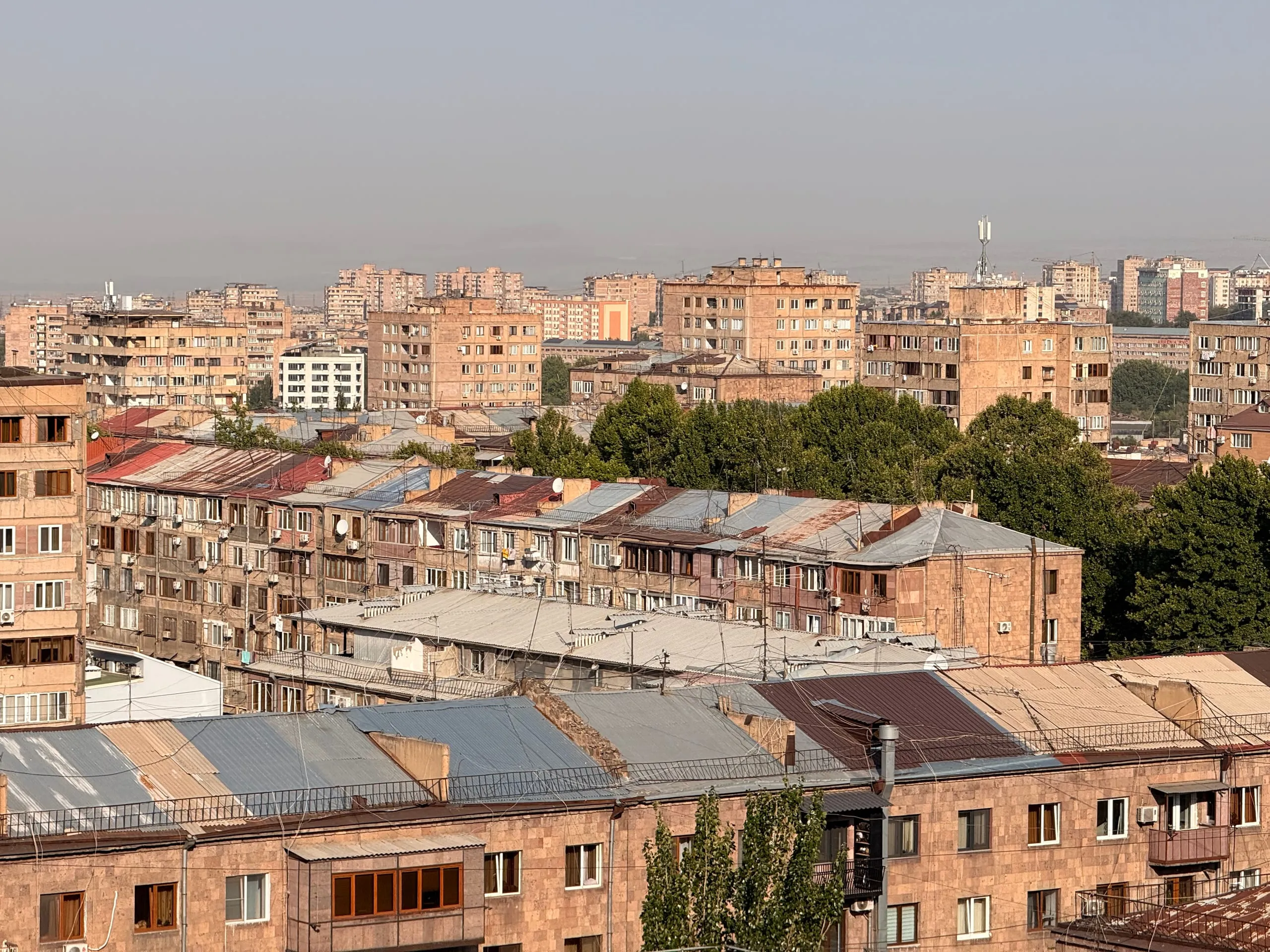
Armenia does the same thing to Soviet modernism that it has done to everything else that ever arrived here: it cuts it out of tuff.
Tuff is compacted volcanic ash, and this country is made of the stuff — pink, orange, grey-lilac — soft enough to saw into blocks and hard enough that the churches built from it in the seventh century are still standing. So when the Soviet Union turned up with a plan for what a modern republic should look like, Armenia built the plan and faced it in the same stone it had been cutting for fourteen hundred years. The modernism here doesn’t look like the modernism anywhere else in the union. Same shapes, warmer material, and in August light the whole thing glows.
Why radials
Every other route in this journal is a line. This one is a wheel.
Armenia is small and Yerevan sits in the middle of it, so nothing worth driving to is more than about two hours away, and every road comes back to the same city because that is what the roads were built to do. You take one bed for four nights and go out and back: north-west on the first day, north-east on the second, then the city itself, then the airport. Under three hundred kilometres in total, and you never pack a bag twice.
I have done trips where the driving was the point. This isn’t one, and it is better for it.
What’s on it
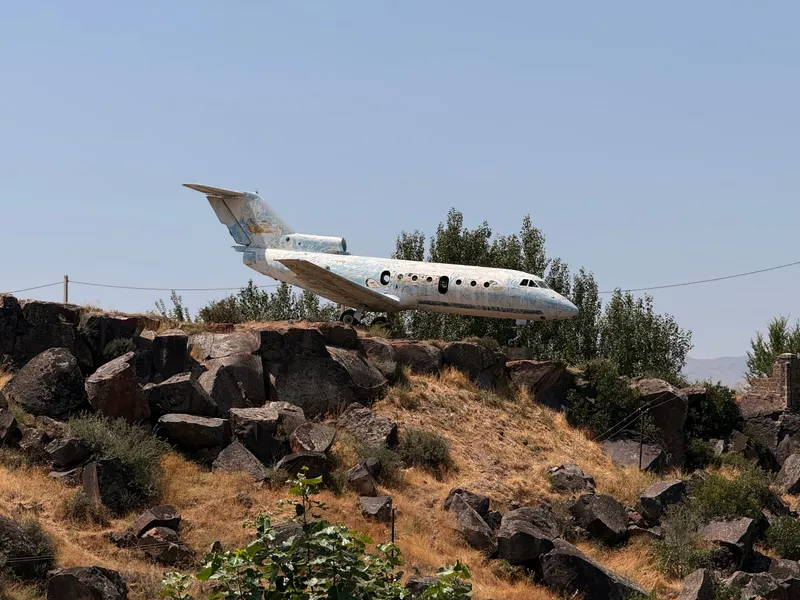
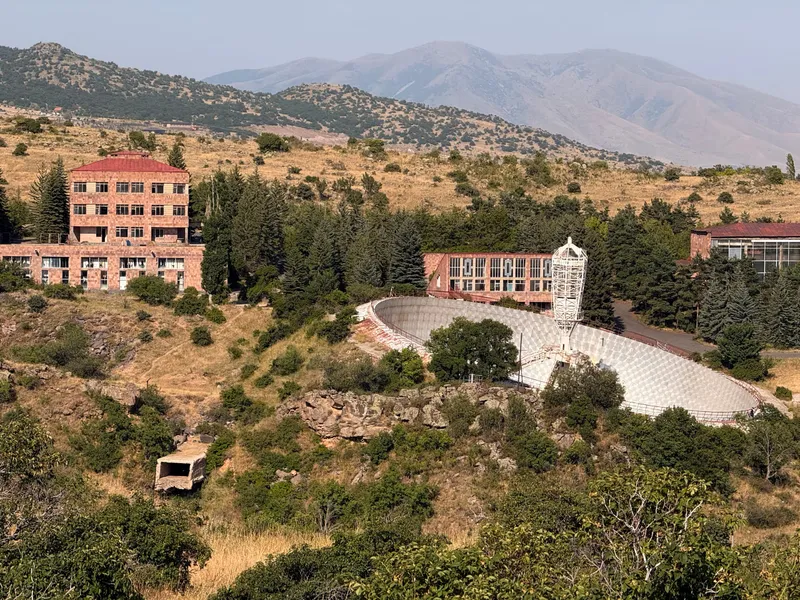
The north-west day carries the two best things on the route. A Yakovlev Yak-40 standing on concrete blocks on a shelf of black basalt above a gorge, nowhere near an airport, with nothing at all to stop you climbing onto the wing. And then, an hour further up and a great deal higher, fifty-four metres of mirror telescope lying in a fold of Mount Aragats: four thousand panels, optically perfect, switched off since 2012 and waiting for somebody to decide it is worth paying for. That one is not a ruin. It is an instrument on hold, and it is the reason I went to Armenia at all.
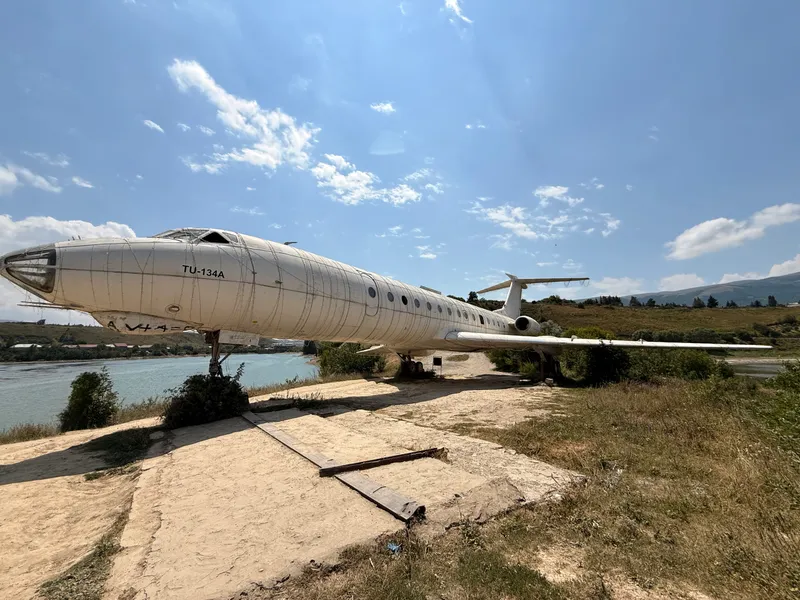
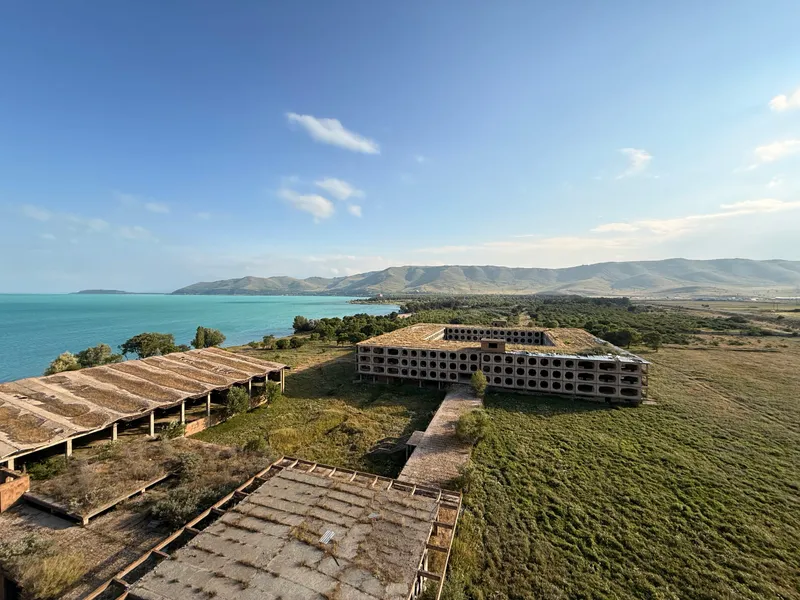
The north-east day gives you the second aircraft — a Tupolev parked on a bluff above a reservoir and rigged wing to wing with festoon lighting, because somebody turned it into somewhere to have a party — and then Lake Sevan at nineteen hundred metres, where an entire resort complex stands on the grass above the water having never been finished, never been glazed, and never had a single guest.
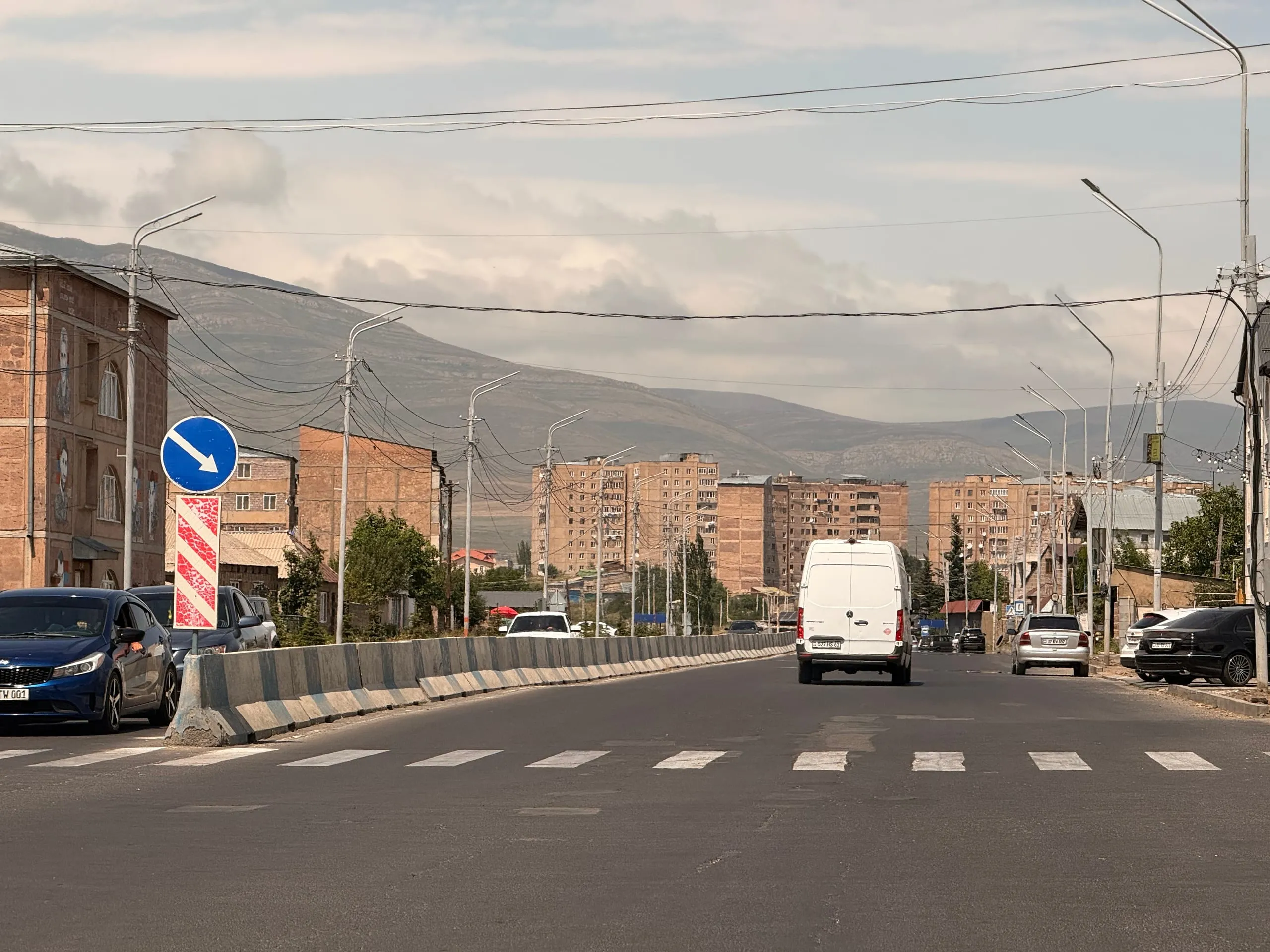
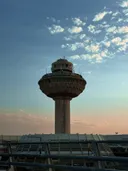
Then the city, which is the part people skip and the part this route is actually arguing about. And then Zvartnots on the way out, where the control tower is a concrete flying saucer on a stalk, because in the 1970s that is what an airport was for.
Four days, one bed, and a country that faced the future in pink stone.
Side stops
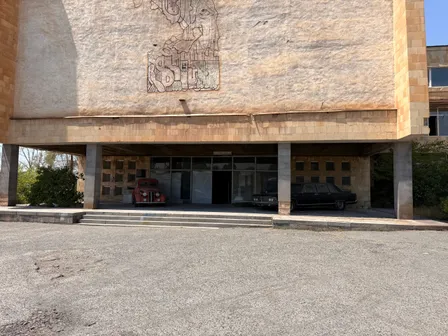
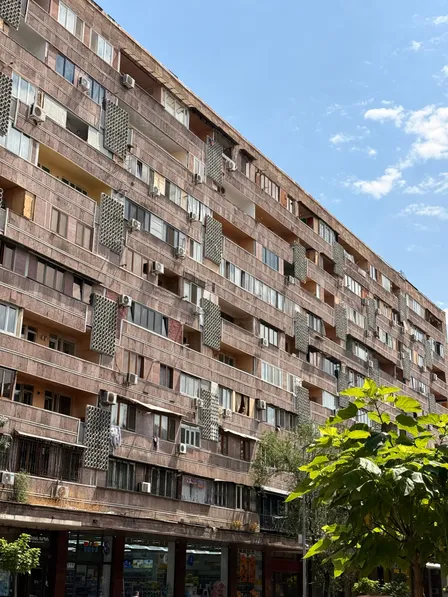
Four of the places on this route are smaller than an entry and don’t appear in the journal’s index at all: a half-working film studio with a row of dead cars parked underneath it, a residential block long enough to close a street and completely full, a metro station built to carry daylight underground, and the old terminal at the airport. I gave one of them an afternoon. One I photographed over a railing on the way to a plane.
They’re on the map with everything else. Whether they’re worth your time is a decision I would rather you made than have me make it for you by leaving them out.
How to use this
Every stop here is somewhere you can stand and look from public ground. This is a route past these buildings, not a way into them — and on this particular route that matters more than usual, because half of it is in use: a studio with people working in it, a station with trains in it, a block with families in it, an airport with aircraft on it.
The map below has each stop, where to leave the car, and what you can see from where you leave it. The drive above is broken into four days that each start and end in the same city, with honest times — meaning what it actually takes, including the hour you spend walking up a mountain that no routing engine will ever tell you about.
- 01 YerevanArmenfilm
Barely out of the city. Go before the sun is overhead — the undercroft where the cars are is deep shade, and the drawing on the wall above it isn't.
0.3 h · 9 km
- 02
Straight on out of town along the gorge. You will see the aircraft from the road before the sat-nav mentions it — there is nothing else up on that rock.
0.4 h · 18 km
- 03
Up onto the shoulder of Aragats. The road gives out before the telescope does — leave the car at the village and walk the last of it, which in August is the hardest hour of the trip.
0.75 h · 25 km
- 04 Orgov Yerevan
Back down in the dark, which is what staying for the light costs you. Nothing on this road is lit and the drop is on your side going down.
1.2 h · 55 km
- 05 YerevanHrazdan
Members
1 h · 50 km
- 06
Members
0.75 h · 40 km
- 07 Lake Sevan Yerevan
Members
1.2 h · 65 km
- 08 YerevanThe long block
Members
0.25 h · 3 km
- 09
Members
0.25 h · 2 km
- 10 YerevanZvartnots
Members
0.4 h · 15 km
The walk up to the telescope
The dish sits at about 1,700 metres and the last stretch is on foot, up a road that goes soft in the heat, with no shade anywhere on it and nothing to drink at the top. In August that is a genuinely hard hour, and it is an hour each way — I walked back down after sunset. Take two litres a head, a hat, and more time than you think. Altitude does the rest: it is thinner up there than the number suggests and the sun is harder. Don't plan anything after it.
Sevan is a frame, not a building
The resort complex above the lake was never finished, which means it was also never made safe. There is no glazing anywhere, so every opening is a hole; the floor slabs are bare, the roofs are bare, and in places there is nothing at all between a floor and a drop. Decades of weather have been working on it and nobody maintains it, nobody owns responsibility for you, and one loose sheet of roofing is the only thing you'll hear moving. The whole complex reads beautifully from the grass, which is where the photographs on this route were taken from.
Two of these stops are somewhere people live and work
The long block is a full residential building — hundreds of homes, washing on the balconies, shops underneath. The film studio is half in use. Both are worth standing in front of and neither is a ruin you get to wander around. Photograph the architecture from public ground, don't shoot into anybody's windows, and don't go through a door because it happens to be open. This is the difference between a route past a building and a problem.
Getting there, and the closed borders
Armenia's land borders with Turkey and Azerbaijan have been shut for decades, so you arrive by air or overland from Georgia — which is why this route starts and ends at an airport instead of a frontier. That also makes a hire car the only sensible way to do it: the stops are spread over a hundred kilometres of mountain road and the public alternative is other people's timetables. Check the current position before you plan around any of it; this is a region where that changes.
These are drive-pasts
Every stop here is somewhere you can stand, look and photograph from public ground. This is a route past these buildings, not a way into them. One is a working film studio, one is a live international airport, one is a metro station in daily use, one is people's homes, and one is an unfinished concrete frame that nobody has ever made safe. What the map gives you is where to be and what you can see from there. What you do after that is yours, and so is the responsibility.
The whole guide — 8 places, unlocked.
- All 8 places on one map — four route stops and four side stops
- Where each one is — exact where it's already public, otherwise a ~1 km area
- Where to leave the car, and what you can see from there
- Every new route added to the journal, included
One membership unlocks every guide and every location.
Grounded
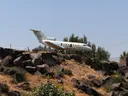
A Soviet regional jet standing on concrete blocks on a shelf of basalt above the Kasagh gorge, nowhere near an airport. Built in 1977 to work grass and dirt strips, retired in 1997, then hauled up onto a cliff by somebody who left no record of why.
Switched Off
Fifty-four metres of mirror set into a hillside at 1,700 metres, four thousand panels, a five-metre secondary hanging over the bowl — and nothing wrong with any of it. Switched off in 2012, and nothing has come through it since. It hasn't been abandoned, though. People are still fighting to get it running, and still waiting for someone to fund it.
Strung with Lights
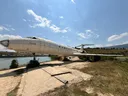
A Tupolev Tu-134A parked on a bluff above a reservoir on the road to Lake Sevan, seventeen hundred metres up — sun-bleached, glazed bomber's nose, nobody around. And run the whole length of it, out along both wings, off the tailplane and down to pegs in the dirt, a rig of festoon lighting. It isn't a wreck. It's a venue waiting for dark.
Stopped at the Frame
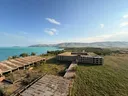
A resort complex on the shore of Lake Sevan at 1,900 metres — two towers standing apart on the grass, a hundred metres of colonnade, and one whole facade built out of stacked concrete rings, all of it faced in pink volcanic tuff. None of it was ever finished. No glass, no floors, no guests — just decades of weather and one loose sheet of roofing working in the wind.
Smaller than an entry and kept out of the index — a working metro station, a lived-in block, a studio yard. Some I stood in front of for ten minutes. They're on the map with everything else, so you can decide for yourself whether to give them an hour.
-
 Semi-activeYerevan Armenia
Still on the Lot
The film studio Soviet Armenia made its pictures in, out on the north-west edge of Yerevan, half working and half not. Under the raised block, out of the sun, a row of old cars that stopped being transport a long time ago — a black government limousine going to rust, a round-shouldered red saloon, two dark Zhigulis. Nobody stopped me looking. Nobody explained them either.
-
 InhabitedYerevan Armenia
Lived In
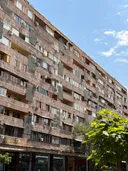
The largest residential building in Yerevan — a wall of flats long enough to close the end of a street, and not one square metre of it empty. Every balcony on it has been glazed in, bricked up, extended or grilled over, each one differently, for fifty years. This journal is mostly buildings nobody wanted. This is the other thing that happened to Soviet housing.
-
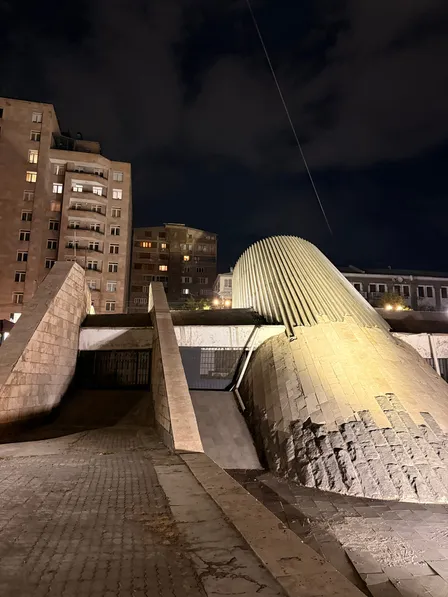 ActiveYerevan Armenia
Daylight, Underground
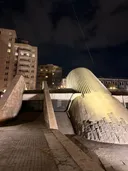
A Yerevan metro station where the architects refused to accept that underground has to mean dark. Instead of a hole in the pavement, a ribbed shell the size of a small hangar breaks out of the ground at an angle and runs down into it, carrying the sky along with it. At eleven at night it works in reverse, and the station lights the street.
-
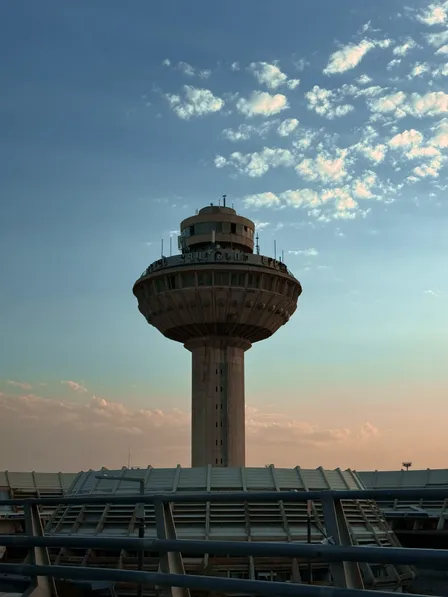 SupersededZvartnots Armenia
Last Look
The old round terminal at Zvartnots, and the control tower standing over it on a single concrete stalk — a flared disc with a ring of portholes set into its underside and Armenian letters around the rim, which is what a 1970s airport thought the future looked like. The last thing I photographed in Armenia, over a railing, on the way to the plane.
- One bed, four days
- The telescope is the whole day
- Water for the walk up
- Early or late, never noon
- Drams, in cash
- Download the maps
- Both aircraft, one trip
- The metro twice
- The housing is the subject
- Nothing flies at Zvartnots
10 field notes, and the advice on 6 of the 10 legs, come with the guide. Unlock them below.